
Content Velocity: Why Speed Is the New Quality



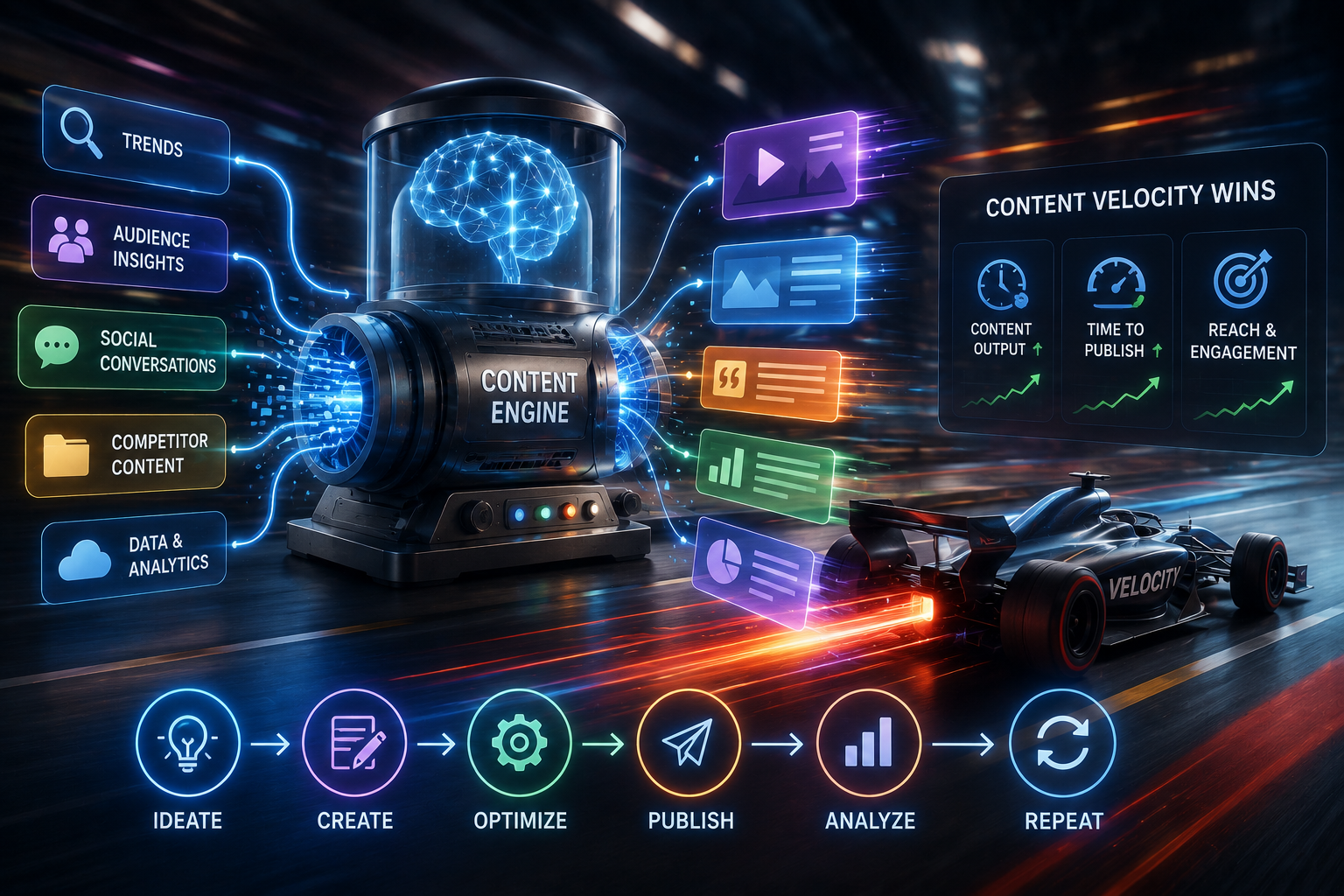
In 2026, the brands that win aren’t the ones with the best single piece of content. They’re the ones with the fastest content engine. Here’s how to build one.
Read more: Content Velocity: Why Speed Is the New QualityFor years, content marketing followed a familiar playbook.
Brands spent weeks researching a topic, crafting a single article, designing supporting graphics, securing approvals, and finally publishing the finished piece. The goal was simple: create the highest-quality content possible.
That strategy worked when content competition was relatively low.
In 2026, however, the rules have changed.
Every day, millions of articles, videos, podcasts, social posts, newsletters, and AI-generated assets are published online. Consumers are exposed to more content than ever before, while algorithms increasingly reward consistency, relevance, and freshness.
As a result, a new competitive advantage has emerged:
Content velocity.
The brands seeing the strongest growth today are not necessarily creating the best individual piece of content. They’re building systems that allow them to consistently create, distribute, optimise, and repurpose content faster than their competitors.
In today’s market, speed is becoming just as important as quality.
And in many cases, it matters more.
What Is Content Velocity?
Content velocity refers to the speed at which an organisation can produce, publish, distribute, and learn from content.
It is not simply about publishing more content.
It’s about creating a repeatable engine that continuously generates relevant content across multiple channels.
A high-content-velocity organisation can:
- Identify opportunities quickly
- Produce content efficiently
- Distribute content across platforms
- Gather performance insights rapidly
- Optimise based on real-world data
- Repeat the process continuously
The faster this cycle becomes, the faster a brand can adapt to market changes and audience behaviour.
Why the Old Content Model Is Breaking Down
The traditional content model often prioritised perfection.
Teams would spend significant time refining every headline, polishing every sentence, and debating every design element.
While quality remains important, perfection has become increasingly expensive.
By the time many organisations publish content, the conversation has already moved on.
Trends change quickly.
Search behaviour evolves rapidly.
AI-powered discovery systems update continuously.
Audience attention shifts daily.
In this environment, slow content production creates a competitive disadvantage.
The opportunity cost of waiting has become larger than the benefit of endless refinement.
The Rise of AI-Powered Content Competition
Artificial intelligence has dramatically increased the amount of content being produced across every industry.
Businesses can now generate:
- Articles
- Social media posts
- Video scripts
- Email campaigns
- Ad copy
- Research summaries
- Content briefs
in a fraction of the time previously required.
This doesn’t mean AI automatically creates better content.
It means competitors can move faster.
When every company has access to AI-assisted production, the differentiator is no longer who can create content.
The differentiator becomes who can operate the most effective content system.
Why Speed Creates Competitive Advantage
Content velocity impacts growth in several important ways.
Faster Market Visibility
The more consistently a brand publishes, the more opportunities it has to appear in search results, AI recommendations, social feeds, and industry conversations.
Visibility compounds over time.
A company publishing 100 valuable pieces of content annually creates significantly more discovery opportunities than a company publishing 10.
Faster Learning
Every piece of content generates data.
Brands learn:
- Which topics resonate
- Which channels perform best
- Which messages drive conversions
- Which audiences engage most
A faster publishing cycle creates more feedback loops.
More feedback leads to better decisions.
Better decisions accelerate growth.
Greater Topical Authority
Search engines and AI systems increasingly reward brands that demonstrate expertise through consistent publishing.
One exceptional article rarely establishes authority.
A large library of useful content often does.
High content velocity helps organisations build that authority faster.
Faster Response to Trends
Markets change quickly.
New technologies emerge.
Consumer behaviour evolves.
Industry news breaks daily.
Brands with agile content systems can respond immediately, while slower competitors remain stuck in approval cycles.
The Difference Between Speed and Content Spam
When marketers hear “publish faster,” they often assume it means sacrificing quality.
That’s not the goal.
High-performing content organisations focus on sustainable speed rather than reckless volume.
The objective is not to flood the internet with low-value content.
The objective is to remove unnecessary bottlenecks.
This means:
- Reducing approval delays
- Streamlining workflows
- Repurposing existing assets
- Automating repetitive tasks
- Using AI strategically
- Prioritising useful content
The best content engines increase both speed and effectiveness.
How Leading Brands Build Content Engines
The most successful organisations approach content like a system rather than a series of individual projects.
Start with Pillar Content
Instead of creating dozens of disconnected assets, leading brands begin with comprehensive pillar content.
Examples include:
- Industry reports
- Expert interviews
- Research studies
- In-depth articles
- Webinar recordings
These assets become the foundation for multiple content formats.
Repurpose Everything
One high-quality asset can generate:
- Blog posts
- LinkedIn articles
- Social media posts
- Email newsletters
- Short-form videos
- Infographics
- Podcast clips
Content velocity increases dramatically when teams stop creating everything from scratch.
Use AI as a Force Multiplier
AI is most effective when it accelerates production rather than replaces expertise.
Many teams now use AI for:
- Research support
- Topic ideation
- Draft generation
- Content summarisation
- Repurposing
- SEO optimisation
Human expertise remains essential for strategy, accuracy, and originality.
However, AI removes many time-consuming production tasks.
Create Repeatable Workflows
Fast organisations rely on systems rather than heroics.
Documented workflows help teams move efficiently from idea to publication.
This includes:
- Content calendars
- Approval processes
- Asset libraries
- Templates
- Distribution frameworks
The less time spent reinventing processes, the more time available for creating value.
Why Content Velocity Matters for AI Search
The rise of AI-powered search is creating additional incentives for faster publishing.
Platforms such as ChatGPT, Perplexity, and Google AI Overview increasingly surface brands that consistently publish useful and authoritative content.
Fresh information often receives greater visibility.
Brands that publish regularly create more opportunities to be cited, referenced, and recommended by AI systems.
This makes content velocity not just a marketing advantage but also a discoverability advantage.
The New Content KPI
Historically, content teams measured success through:
- Traffic
- Rankings
- Engagement
- Shares
While these metrics still matter, leading organisations are increasingly tracking operational metrics as well.
Examples include:
- Content production rate
- Time to publish
- Repurposing efficiency
- Content output per team member
- Content-to-revenue contribution
These measurements help organisations improve the speed and effectiveness of their content engine.
The Future Belongs to Fast Learners
The companies winning in 2026 understand a simple truth:
Content is no longer a campaign.
It’s an operating system.
The internet rewards consistency more than occasional brilliance.
Search engines reward expertise demonstrated over time.
AI recommendation systems reward authoritative content ecosystems.
Audiences reward brands that consistently provide useful information.
Quality remains essential.
But quality without speed is increasingly invisible.
The brands that thrive over the next decade will not be those producing one perfect piece of content every few months.
They will be the organisations that build fast, intelligent, scalable content engines capable of learning, adapting, and publishing continuously.
Because in the age of AI-powered discovery, the winners are not necessarily the brands creating the best content.
They’re the brands creating momentum.
Post a Comments
Your email address will not be published. Required fields are marked *
Ready to grow?
Contact us Now.




 IMPACTFUL AI ACCURACY
REGIONAL SINGAPORE SUPPORT
IMPACTFUL AI ACCURACY
REGIONAL SINGAPORE SUPPORT