
How Singaporean Parenting Brands Are Winning with AI-Powered Content



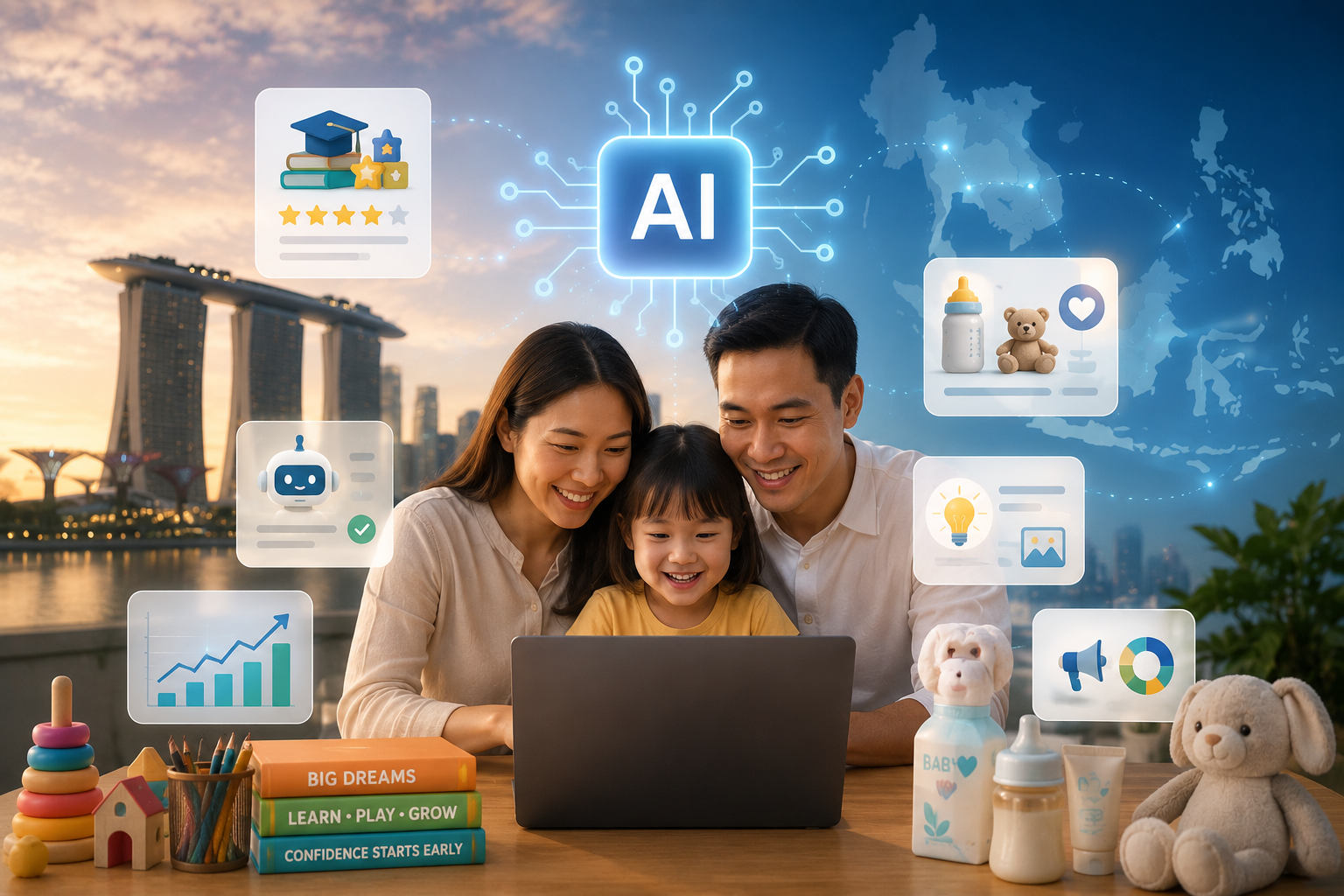
From enrichment schools to baby products — the playbook for family-focused brand growth in Southeast Asia, powered by AI.
Read more: How Singaporean Parenting Brands Are Winning with AI-Powered ContentThe parenting market in Southeast Asia has never been more competitive.
From enrichment centres and preschools to baby products, healthcare providers, and family services, brands are competing for the attention of increasingly informed parents. Today’s consumers conduct extensive research before making decisions, compare multiple options, read reviews, seek recommendations, and expect brands to provide value long before a purchase is made.
At the same time, content demand has exploded.
Parents are searching for answers across Google, ChatGPT, social media platforms, YouTube, parenting forums, and AI-powered search tools. They expect relevant, trustworthy information at every stage of their decision-making journey.
For many businesses, keeping up feels impossible.
That’s why some of the fastest-growing parenting brands in Singapore are turning to AI-powered content strategies—not to replace human expertise, but to scale it.
The result is a new competitive advantage: the ability to create more useful content, reach more parents, and build trust faster than ever before.
The New Reality of Parenting Marketing
Parents today don’t simply buy products.
They buy confidence.
Whether they’re choosing an enrichment programme, selecting a baby formula, researching childcare options, or purchasing educational toys, they’re making decisions that affect their children’s wellbeing.
As a result, trust has become the most valuable asset in the parenting sector.
Modern parents typically go through a complex research process:
- Searching Google for information
- Asking questions in parenting communities
- Watching educational videos
- Comparing reviews
- Consulting AI search tools
- Reading expert content
- Seeking recommendations from other parents
Brands that consistently appear throughout this journey gain a significant advantage.
This is where content becomes a growth engine.
Why AI Is Transforming Content Creation
Traditional content marketing often struggles with scale.
Many parenting brands publish a few blog posts each month, create occasional social media content, and send newsletters when time allows.
Meanwhile, consumer demand for information continues to grow.
AI-powered workflows are helping brands bridge this gap.
Instead of spending weeks producing a single article, marketing teams can now:
- Research parenting trends faster
- Generate content outlines
- Identify high-intent search topics
- Repurpose content across multiple channels
- Personalise messaging for different audience segments
- Scale content production without proportionally increasing costs
The goal isn’t simply producing more content.
It’s producing more relevant content.
How Leading Parenting Brands Are Using AI
Across Singapore and Southeast Asia, successful family-focused brands are adopting AI in several practical ways.
Building Topic Authority
Many brands are shifting away from promotional content and focusing on educational resources.
For example, an enrichment centre may create content around:
- Early childhood development
- Learning strategies
- School readiness
- Study habits
- Emotional intelligence
- Parent-child communication
Similarly, baby product brands may publish resources covering:
- Infant nutrition
- Sleep routines
- Development milestones
- Safety recommendations
- Parenting challenges
AI helps identify related topics, content gaps, and frequently asked questions that parents are actively searching for.
Over time, this creates topical authority that improves visibility across search engines and AI recommendation platforms.
Creating Content for Every Stage of the Parenting Journey
One of the biggest advantages of AI is its ability to support content creation across the entire customer journey.
Awareness Stage
Parents often begin with broad questions such as:
- How do I prepare my child for primary school?
- What are the signs of developmental delays?
- How much screen time is appropriate?
Educational content addressing these topics helps brands reach audiences before they’re actively shopping.
Consideration Stage
As parents evaluate options, they look for more detailed information.
Examples include:
- Comparing enrichment programmes
- Understanding curriculum differences
- Evaluating childcare options
- Reviewing product features
This is where expert guides, comparison articles, and case studies become valuable.
Decision Stage
At this point, parents want reassurance.
Success stories, testimonials, FAQs, and practical demonstrations help reduce uncertainty and increase conversion rates.
AI enables brands to produce content tailored to each stage more efficiently than traditional methods alone.
Winning in AI Search
Another major shift is occurring beyond traditional search engines.
Parents are increasingly asking AI tools questions such as:
- What are the best enrichment centres in Singapore?
- Which baby products are recommended for newborns?
- What educational activities improve early learning?
Platforms like ChatGPT, Perplexity, and Google AI Overview are becoming part of the discovery process.
This means brands must optimise not only for Google rankings but also for AI recommendations.
Successful brands are investing in:
- Expert-led content
- Comprehensive resource libraries
- Structured website content
- Frequently asked questions
- Original insights and research
- Consistent publishing schedules
These signals help AI systems recognise a brand as a trustworthy source of information.
Scaling Content Without Sacrificing Quality
One common misconception is that AI-generated content automatically leads to lower quality.
The most successful parenting brands take a different approach.
They combine:
- Human expertise
- Professional editing
- Industry knowledge
- AI-assisted production
In this model, AI accelerates research, drafting, and optimisation while human experts ensure accuracy, credibility, and authenticity.
The result is content that remains trustworthy while being produced at a much greater scale.
Why Southeast Asia Presents a Unique Opportunity
Southeast Asia’s parenting market is experiencing rapid growth.
Rising incomes, increasing digital adoption, and strong investment in education have created significant opportunities for family-focused brands.
Singapore, in particular, serves as an influential hub for innovation and consumer trends across the region.
Brands that establish authority in Singapore often find it easier to expand their influence into neighbouring markets such as:
- Malaysia
- Indonesia
- Thailand
- Vietnam
- The Philippines
AI-powered content strategies make this expansion more achievable by helping teams manage larger volumes of content while maintaining consistency.
The Playbook for Growth in 2026
The parenting brands seeing the strongest growth today share several characteristics:
They educate before they sell.
They answer questions before customers ask them.
They invest in authority rather than short-term visibility.
And increasingly, they use AI to amplify their expertise rather than replace it.
As consumer behaviour evolves and AI search becomes more influential, content is no longer simply a marketing asset.
It is becoming the foundation of discoverability, trust, and long-term growth.
For parenting brands across Singapore and Southeast Asia, the opportunity is clear.
The winners won’t necessarily be the companies with the largest budgets.
They’ll be the brands that consistently provide the most valuable answers to the questions parents care about most—and use AI to do it at scale.
Post a Comments
Your email address will not be published. Required fields are marked *
Ready to grow?
Contact us Now.




 IMPACTFUL AI ACCURACY
REGIONAL SINGAPORE SUPPORT
IMPACTFUL AI ACCURACY
REGIONAL SINGAPORE SUPPORT