
The Rise of AI Event Intelligence: Why Smart Exhibitors Are Winning



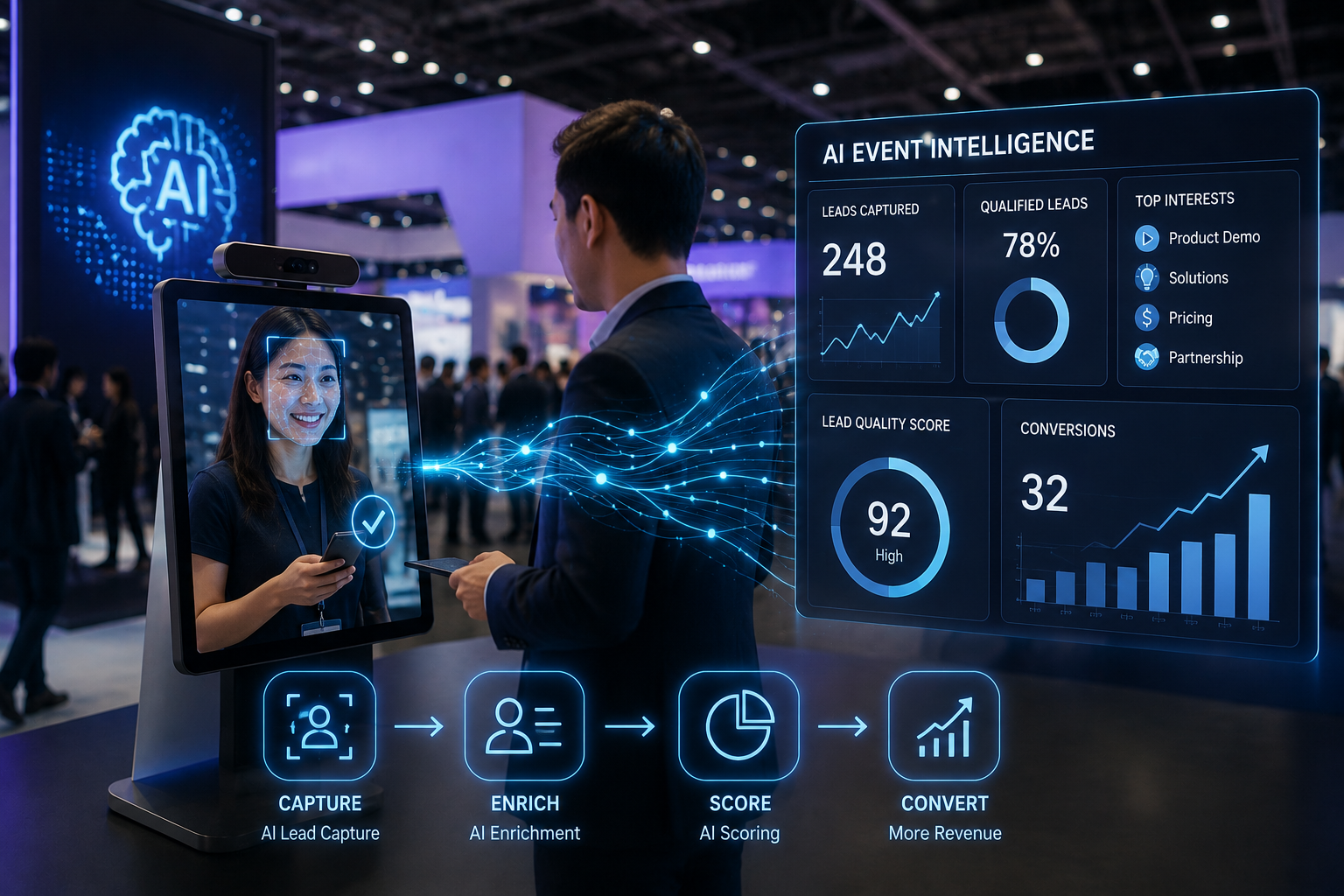
Events are back — but the smart money is on AI-powered lead capture, not business cards. Here’s how to turn your booth into a data machine.
Read more: The Rise of AI Event Intelligence: Why Smart Exhibitors Are WinningTrade shows, conferences, exhibitions, and industry events are back in full force.
Across Singapore and Southeast Asia, businesses are once again investing heavily in face-to-face networking, product showcases, and live customer engagement. Event halls are crowded, booths are bigger, and marketing teams are eager to reconnect with prospects in person.
But while events have returned, the way successful exhibitors measure success has fundamentally changed.
The old model was simple:
Collect as many business cards as possible.
Scan a few badges.
Follow up with everyone after the event.
Hope something converts.
Unfortunately, hope is not a strategy.
In 2026, the smartest exhibitors are treating events as data-generating platforms rather than networking opportunities alone. Powered by artificial intelligence, modern event intelligence systems are helping companies identify high-value prospects, prioritise follow-ups, and measure event ROI with unprecedented accuracy.
The result is a new competitive advantage: exhibitors who can transform every booth interaction into actionable business intelligence.
The Problem with Traditional Lead Capture
Most event teams are familiar with the same recurring challenges.
A booth attracts hundreds of visitors over several days.
Staff members have dozens of conversations.
Business cards pile up.
Badge scans accumulate.
Then reality sets in.
Who was genuinely interested?
Who had purchasing authority?
Who requested a follow-up?
Who was simply collecting freebies?
Without meaningful context, every lead looks the same.
Sales teams often spend weeks chasing low-intent prospects while genuinely valuable opportunities slip through the cracks.
This is where traditional lead capture falls short.
It collects contact information but provides very little intelligence.
Enter AI Event Intelligence
AI Event Intelligence goes beyond capturing names and email addresses.
It helps businesses understand the quality, intent, and value of every interaction.
Instead of creating a spreadsheet full of contacts, AI creates a rich dataset that helps teams make smarter decisions.
Modern event intelligence platforms can analyse:
- Visitor engagement levels
- Booth interaction history
- Product interests
- Session attendance
- Conversation notes
- Lead qualification data
- Follow-up behaviour
- Purchase intent signals
The result is a much clearer picture of which prospects deserve immediate attention.
Why Lead Quality Matters More Than Lead Volume
For years, exhibitors measured success by the number of leads collected.
The assumption was simple:
More leads equals more opportunities.
However, many organisations are discovering that lead volume often masks poor performance.
Consider two exhibitors:
Company A collects 1,000 badge scans.
Company B collects 250 highly qualified prospects.
If Company B converts 20% of its leads while Company A converts only 1%, the smaller lead list generates significantly more revenue.
AI helps organisations focus on quality rather than quantity.
Instead of asking:
“How many leads did we collect?”
The better question becomes:
“How many qualified buying opportunities did we identify?”
How AI-Powered Lead Capture Works
Today’s event technology has evolved far beyond manual note-taking.
Modern systems can combine multiple data points to create detailed prospect profiles in real time.
Smart Qualification
AI-powered forms and conversational interfaces can dynamically adjust questions based on visitor responses.
This helps exhibitors gather more meaningful information without creating friction.
For example, a visitor expressing interest in enterprise solutions may receive different qualification questions than a visitor researching options for a small business.
Automated Lead Scoring
AI can evaluate engagement signals and assign scores based on purchase likelihood.
Factors may include:
- Job title
- Industry
- Company size
- Product interest
- Budget indicators
- Interaction duration
- Requested follow-up actions
This allows sales teams to focus their attention on prospects with the highest probability of conversion.
Real-Time Insights
Rather than waiting until after an event, exhibitors can monitor performance throughout the day.
Teams can identify:
- Which products attract the most interest
- Which conversations generate qualified leads
- Which audience segments engage most frequently
- Which booth activities drive meaningful interactions
These insights allow teams to optimise performance while the event is still taking place.
Turning Your Booth into a Data Machine
The most successful exhibitors no longer view their booth as a physical display.
They view it as a data collection ecosystem.
Every interaction generates valuable information.
Every question reveals intent.
Every engagement creates insight.
To achieve this, leading organisations integrate multiple touchpoints throughout the visitor journey.
Examples include:
Interactive Experiences
Digital product demos, assessment tools, quizzes, and configurators help capture engagement data while providing value to attendees.
QR-Based Content Access
Rather than handing out brochures, exhibitors offer downloadable resources through QR codes.
This provides measurable engagement data and creates additional follow-up opportunities.
AI-Powered Chat Interfaces
Interactive kiosks and AI assistants can answer questions, gather visitor information, and qualify leads automatically.
This helps reduce bottlenecks during busy exhibition periods.
CRM Integration
Modern event intelligence platforms connect directly with CRM systems, ensuring sales teams receive enriched lead profiles immediately after interactions occur.
The result is faster follow-up and better conversion rates.
Measuring Event ROI More Accurately
One of the biggest frustrations in event marketing has always been proving return on investment.
Booths, sponsorships, travel, and staffing require significant budgets.
Yet many organisations struggle to connect event activity with actual revenue outcomes.
AI is changing that.
Modern event intelligence platforms can help track:
- Pipeline generated
- Sales opportunities created
- Revenue influenced
- Revenue closed
- Lead-to-opportunity conversion rates
- Opportunity-to-customer conversion rates
Instead of reporting how many visitors attended a booth, marketing teams can demonstrate business impact in financial terms.
This makes events easier to justify and easier to optimise.
Why Early Adopters Are Gaining an Advantage
As AI-powered event technologies become more accessible, a gap is emerging between traditional exhibitors and data-driven exhibitors.
Traditional teams continue collecting contact information.
Modern teams collect intelligence.
Over time, this difference compounds.
Companies with stronger event intelligence can:
- Prioritise leads more effectively
- Shorten sales cycles
- Improve conversion rates
- Reduce wasted follow-up efforts
- Increase event ROI
- Make better future event decisions
In highly competitive industries, these advantages quickly become significant.
The Future of Event Marketing
Events are no longer just about visibility.
They’re about intelligence.
As AI continues to reshape how businesses collect, analyse, and act on data, exhibitors that embrace these technologies will gain deeper insights into customer behaviour and buying intent.
The companies generating the strongest event results in 2026 are not necessarily the ones with the largest booths or the biggest giveaways.
They’re the ones using AI to understand their audience better than their competitors.
Business cards may still have a place.
But the future belongs to organisations that can transform every conversation, interaction, and engagement into actionable data.
Because in the modern event landscape, the real asset isn’t the contact list.
It’s the intelligence behind it.
Post a Comments
Your email address will not be published. Required fields are marked *
Ready to grow?
Contact us Now.




 IMPACTFUL AI ACCURACY
REGIONAL SINGAPORE SUPPORT
IMPACTFUL AI ACCURACY
REGIONAL SINGAPORE SUPPORT